Shareholders in Tesco have had a miserable year….
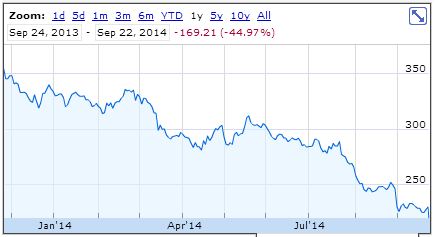
The latest news that it overstated it’s results in the last 6 monthly statements by £250m, it has asked four senior directors to ‘step aside’ seems like the final kick in the nuts that follows the recent slashing of the dividends paid out to shareholders.
My first thought when I read the latest news is that when you say your trading profit (of £1.1bn) was overstated by £250m you’re not talking small beans. The fact that four directors have been shown the door implies to my suspicious mind that there has been some foul play. If someone wasn’t cooking the books, then such an error must be down some some pretty serious incompetence. As a shareholder, incompetence and/or fraud aren’t ideal attributes to find in a company you own a stake of.
Lack of Strategy
Tesco used to be the great cost leader in the industry. It wasn’t too long ago that the masses were enthralled about the huge range of cheap delights the company was offering in it’s ever increasingly large hypermarkets (remember the famous £4 jeans?). They didn’t stop at jeans either, it wasn’t long before they were selling books, cds, dvds and even flat screen TVs. The idea was that we’d all only ever go shopping once per week, to Tesco.
However times have changed. The masses are more now more comfortable using the likes of Amazon (hell, even my Dad is using it these days) to buy cheap electronics and entertainment media. The lure of hypermarkets seems to have gone somewhat. As lives get busier it seems we want more smaller format convenience stores, particularly if we’re no longer getting rock bottom prices.
So suddenly Tesco has found itself stuck in no mans land. The likes of Lidl and Aldi are the new go to guys if you want cheap (but still good quality) shopping. At the other end of the scale you have Waitrose that welcomes you into the store with a free coffee and friendly staff that can’t do enought to help. I know a couple of former Tesco customers that now frequent Waitrose thanks to the free coffee gimmick, much to the regulars disgust.
Tesco seems to be fighting for the middle ground with Sainsbury’s and losing. In my opinion (for what it’s worth) Sainsburys stores just seem a smidge nicer places to be than Tescos. That said, I’m more of a farm shop + Asian supermarket + cah and carry man myself.
Not so long ago Tesco was committed to a large program (£1bn worth to be exact) of store upgrades. However now that program seems to have been ‘scaled down’ and instead management seem to be engaging in the old retailer classic game of price wars. In my opinion the strategy is muddled. Tesco is trying to be all things to all men and failing. In fact I don’t think it’s trying to be anything anymore, it just can’t decide what to be.
“Unexpected Item in the P&L Area”
Headline of the Week from the FT
Off Balance Sheet Debt
Over the last decade or so Tesco has embarked on a large program of selling it’s property and leasing it back. This type of activity always arouses suspicion to me as it’s the sort of thing that private equity companies do to ‘release value’. I like bricks and mortar and selling off ‘the family silver’ is not something I like to see as it’s almost always for short term gain.
In Tesco’s case the property sales gave two short term benefits:
- It allowed it to reduce balance sheet debt
- Freed up capital to invest in more stores/fund expansion abroad
Unfortunately for Tesco, like many others before it, the much hoped for conquering of the US ended in failure. The sting in the tail is that it now finds itself committed to lots of long term leases that need to be paid for out of future profits. Essentially it has moved a chunk of it’s debt off the balance sheet and simply converted it to future expenses instead as well, oh and it also reduced it’s asset base too. Not ideal.
Ratings
Now we all know what a mess of things the ratings agencies made of things before the credit crisis. That said their data is of use from time to time as a form of second opinion. With a S&P rating of BBB, Tesco is just two rating bands above ‘Non Investment Grade or as other call it ‘Junk’.
Poor Reputation
Supermarkets in general have poor reputations. However it seems in its march for dominance over the last few decades Tesco seemingly led the way (in the masses eyes) when it came to evil deeds. Screwing it’s suppliers, sending farmers to slaughter, bulldozing primary schools to make way for hypermarkets and burning independent high street shops are all standard Tesco practises if you believe the opinion of some people.
In recent years the general consensus seems to be that the stores are tatty and customer service is bad. Tesco is not trying to be a premium brand so it’s staff don’t need to be as friendly as those that work in Waitrose, however being voted the UK’s worst supermarket by Which isn’t going to help your business no matter who you are. Hell even Bryanair are trying to be nice to customers these day.
Conclusion
As you’ve probably gather I’m incredibly bearish about Tesco PLC. The lack of clear strategy, reduced dividends, very weak management and poor financial metrics/trends don’t give me any confidence of a turn around in the short term. I wouldn’t be surprised to see more bad news to follow before the new management team can turn the ship around and save the share price.
However, just how low can Tesco go? Let’s not forget that Tesco’s revenue is in the region of £70bn a year. If it can reverse the trends in sales, improve margins, fight off ze Germans and win back the hearts of its customers then it has a fantastic opportunity to get back on track.
Maybe now is the time to be buying Tesco shares. If the above happens shareholder buying at todays price will make a handsome profit in the future.
This moment in time might be what the Deepwater Horizon was to BP…a fantastic buying opportunity. Well I had the nerve to buy BP shortly after the Deepwater disaster however at this moment in time I just can’t see the story that tells me this isn’t the bottom.
Any thoughts?


Leave a Reply