As I mentioned recently, we rarely watch television in the Money Tree household. When we do, it is more often than not a pre-recorded series via our freeview pvr box. There’s a small number of programs we watch from time to time one of which is Dragons Den.
While Dragons Den is first and foremost an entertainment show, the subject matter (angel investing in small startup businesses) is of interest to an investor such as myself.
Many of the successes and mistakes made by entrepreneurs on the program can be closely relevant for retail equity investors to study. Below we’ll look at a few examples from the Den and try and draw out some lessons for us mortal investors to learn.
Don’t Get Carried Away
When watching Dragon’s Den it’s continually amazing to see entrepreneurs that have (often) spent their whole life savings developing a product quickly get torn apart in the den, usually with nothing more than quick sharp slaps of common sense.
The program highlights perfectly how people can get so wrapped up in an idea that they lose all ability to rationally assess the prospects of their business. Likewise many floored retail equity investments are made with little or no actual research. I’ve known too many acquaintances that will happily invest thousands of hard earned £’s off the back of a briefly bullish article from Motley Fool or the promise of riches in the form of a ‘hot tip’ from a friend in the pub.
The art of successful investing (in my humble opinion) is to leave emotion off the table and to continually question and re-asses the decisions you are making.
Business Ownership v Share Ownership
If you’re a dragon, investing in a private business is in many ways much easier (if more risky) than investing in a listed entity. As a potential part owner you of course need to worry about the size of the businesses the assets, revenues, costs and extrapolate these out along with the future growth potential of the business. Based on their assessment of these things, the dragons may or may not offer some money for a stake in the business.
When looking to buy shares in a listed company, you or I also have to perform the same assessment as the dragons do. However the key difference is that you and I also need to consider the ‘markets’ view on the company. After all it is the market that determines the prices of securities.
For example, after doing your research you may value a company to be worth £10 per share but the market may value it at £15 per share. In such a case (assuming you’re confident in your valuation) then you’ll be overpaying if you rush out and buy the stock today. Instead you should wait until such a time as the market valuation is lower than or equal to your own.
In the den, the dragons are in complete control of what they pay for a slice of the business in front of them. In the stock market you as a retail investor only have access to the price/valuation that the market is offering. As private investors we need to be comfortable that the market will often have a different perception of value and price than we do. It is our job to profit form this mismatch.
Cash is King
Cash is the life and soul of a company. The most common reason for businesses to fail is through a lack of cash flow.
For example in order to make and sell widgets a company needs cash in order to design the widget, buy the raw materials, build/rent a factory, hire a sales team to sell it, deliver lorry loads of widgets to customers. Typically all of the above activities need to be done before the company has received a penny from any customers.
Sure some of the above can be done by using credit (e.g. buying the raw materials) however the product designers and sales teams won’t hang around long if they don’t get paid at the end of the month. Businesses need cash to survive and prosper.
If you can find companies to invest in that bring in a reliable stream of cash profits then you’ll put the investing odds firmly in your favour. It’s no coincidence that many contrarian investors such as Warren Buffet and Terry Smith tend to seek business that produce lots of profits that arrive in the form of cash. Terry sums it up well in this short clip and likewise The Escape Artist recently published a good post on the importance of free cash flows in potential investments.
A good product/service
At the core of every successful company is a good product or service. If the product isn’t up to scratch then customers will stop buying it and pretty soon after that the value of the business (i.e. the share price) will fall (see Tescos recent woes).
Another great example of the importance of products is to look at what has happened to the Apple and Blackberry stock prices in recent years. Bother were fantastically run companies who’s products were popular with consumers. However one of them forgot to innovate and stay in tune with customer demand…
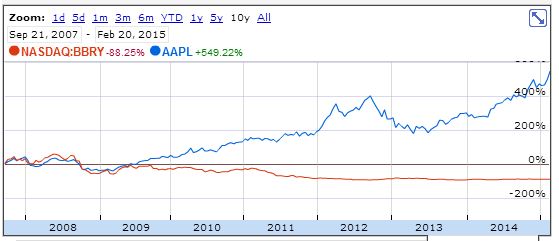
As this amusing clip shows, if the product is cr$p then the associated business wont have a chance…..
https://www.youtube.com/watch?v=oIPFrZY–30
As an investor it’s crucial to understand the how the companies you invest in service the needs of their customers. If you can’t understand the product then you really shouldn’t be investing.
I’m often surprised when friends declare they’re invested in some obscure biotech company when they clearly have no real idea what it is or how that the company does. I’m sure some biotech companies are fantastic companies and great investments however I don’t feel I have the right to invest my future wealth in something I don’t understand.
You Can’t Get It Right All of The Time
Hindsight is a bastard. No matter how much investment success you produce over time you will always be able to look back and see the one that got away.
In the same vein, all bar one of the Dragon’s famously all gave up the opportunity to invest in kids suitcase firm Trunki in 2006. The one that was interested (Richard Farley) priced himself out of the investment by wanting 50% of the company. The firm quickly went on to be a massive success and a missed opportunity for all of the dragons.
When I look back at the ones that got away I try and avoid the obvious feelings of regret and instead attempt to learn something from the experience. If I had invested and made a fortune would it have been luck or skill? Could I have made a huge loss just as easily? If I genuinely made a mistake in my appraisal then I’ll do my damnedest to learn form it.
And Finally…..
Oh and before we’re done here, there is no way I can write this post and not post Cassetteboy‘s take on the Den…
https://www.youtube.com/watch?v=kfQZ_UqMgbo
Happy investing!


Leave a Reply to Cerridwen Cancel reply